


What Product-Market Fit Really Looks Like in Web3
Product-market fit (PMF) has always been the quiet test of truth of any startup. It is the moment when something you have built finally meets a real need. In Web3, that test is harder to pass.
The product is not just software; it is also a market, a governance structure, and an incentive system wrapped into one. The result is that the familiar signs of success, such as growth charts, total value locked (TVL), or daily users, no longer mean what they used to.
The Mirage of Success
In 2021, Terra’s stablecoin $UST looked highly promising with product-market fit. Anchor Protocol promised nearly 20% yields on deposits, and billions of dollars of capital poured in. Total value locked surged, Telegram and Discord channels buzzed with optimism, and for a moment, it seemed like the project had cracked the code to mainstream adoption.
But when rewards were cut and confidence wavered, liquidity drained almost overnight. The peg broke, LUNA spiraled to zero, and what had originally looked like product-market fit revealed itself as an incentive-driven “mirage”.
In Web3, these “mirages” are common. Real product-market fit is rarer and harder to pin down, because your “product” is not just a product in the typical sense. Instead, it is a bundle of interdependent parts. It is the software itself, the token that drives its economy, the governance system, and the community that provides legitimacy and adoption. Miss one of these, and the others can quickly unravel.
All products live in markets. The difference in Web3 is that many products encode their own markets directly into their design. A stablecoin is not just another app inside a financial system, its code literally defines how its currency trades. An automated market maker (AMM) like Uniswap does not just plug into a liquidity market; it is the liquidity market. That collapse of product and market boundaries makes product-market fit unique in this space: a bug fix or governance vote can rewrite the very market your product is supposed to ‘fit’ into.
That’s why product-market fit in Web3 is less about a single metric, like daily active users or net promoter scores (NPS), and more about the alignment of an entire ecosystem. And so, while every founder considers PMF from day zero, the challenge is that here, the fit is multi-dimensional and inherently fragile.
The Classic Definition of Product-Market Fit
Marc Andreessen, co-founder of a16z, once wrote in The Only Thing That Matters: “Product-market fit means being in a good market with a product that can satisfy that market.”
Dan Olsen later broke this into the Product-Market Fit Pyramid.
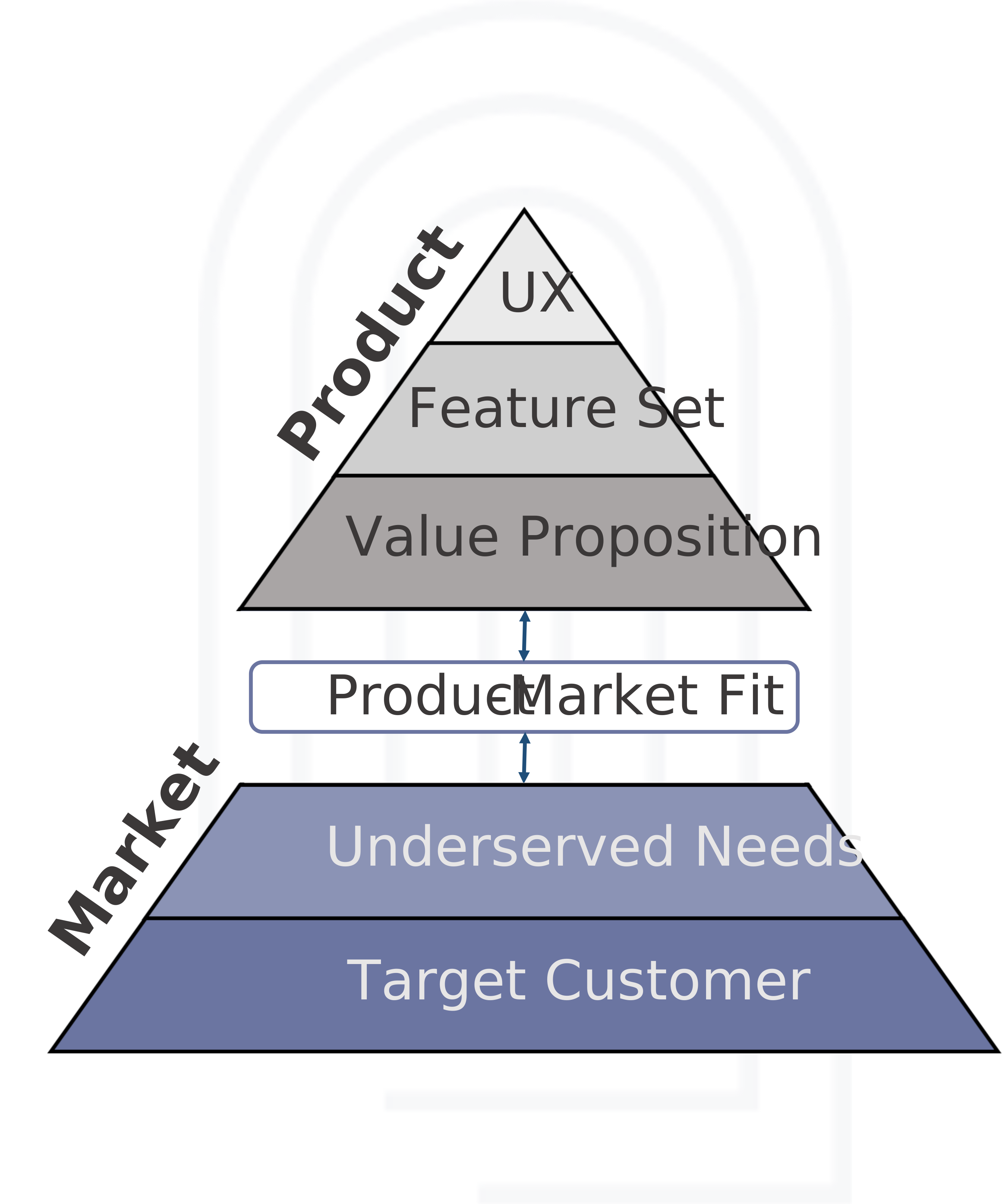
On the market side, you begin by defining your target customer and the underserved needs you want to solve. On the product side, you respond with a value proposition, which you realize through a feature set, delivered through a coherent user experience. Fit happens when the product stack aligns tightly with the market stack. This is when what you have built directly addresses the right needs for the right people.
Steve Blank’s popular “Customer Development” framework added another layer of discipline on top of the pyramid. During the customer discovery phase, instead of assuming your market is whatever broad category you are building in, he argues that you should treat all market sizing, such as total addressable market (TAM), serviceable available market (SAM), and target market, as hypotheses, and not facts. You then go out and test those assumptions with real customer interviews and experiments.
The value of this is simple: it stops founders from confusing a giant category with the sliver they can realistically reach. For example, claiming to be in the “payments” market worth trillions is meaningless if your actual initial target is freelancers in Southeast Asia who need stablecoins for remittances. Discovery forces you to get specific and validate that this segment, with these needs, actually wants your solution.
Now, these frameworks still matter, but in Web3, the signal they rely on can easily get distorted by speculation and vague metrics.
The Five Realities of Product-Market Fit in Web3
In Web3, the familiar rules for finding traction start to bend. The five realities below outline how product-market fit behaves differently, where traditional startup logic breaks, and what it takes to build something long-lasting.
1) False Positives
False positives are everywhere in Web3. Liquidity mining, airdrops, and “points” campaigns can inflate weak signals into strong-looking ones, making speculation easy to confuse with real demand. Metrics like total value locked (TVL), active wallets, or transaction counts may look impressive, but they can (and often do) collapse if rewards fade.
The underlying problem is that financial engineering can simulate traction. It’s easy to create the appearance of demand by subsidizing it. Therefore, many projects end up attracting speculators rather than loyal users, so what appeared to be PMF evaporates in a downturn.
The truth is simpler: product-market fit means creating genuine customer value, not chasing vanity metrics. It shows up as organic cohorts returning without rewards. For example, people keep using a lending protocol because the rates are competitive and the UX is smooth, not because of an airdrop. That persistence is the tell.
2) Product-Market Fit is an Ecosystem, not a Milestone
In Web3, product-market fit is not a milestone you “hit” and then scale from. It is an ecosystem you have to constantly maintain. Rather than being a single achievement, fit is a living equilibrium across product, community, governance, and tokenomics. When these elements reinforce each other, projects can grow sustainably.
In practice, this means founders can’t just track retention curves or NPS. They also need to watch governance participation, incentive durability, and community trust as closely as they monitor usage metrics.
For example, a DAO treasury that stays active across cycles, or a DeFi protocol where fee revenue sustains development without constant token emissions. It’s not one metric; it’s the system reinforcing itself over time.
3) Think Like an Emerging Market Economist
Web3 often feels less like Silicon Valley and more like São Paulo in the 1990s, or Jakarta after the Asian financial crisis: volatile, fast-growing, and light on formal institutions.
Scholars of emerging markets point out that it is not growth in the good times that proves resilience, but how systems behave when shocks hit. Weak governance, shallow trust, and fragmented rules mean cracks appear quickly, and when they do, confidence wavers fast.
Web3 has the same texture. A protocol isn’t just a product in a market; it is closer to a miniature economy where governance, incentives, and community act as the institutions. And unlike traditional economies, these rules aren’t implicit, but they are written in code.
For founders, that means asking: what institutional buffers do we have?
For investors, it means stress-testing designs: if liquidity flees, can the system stabilize? If governance is captured, does legitimacy collapse? In Web3, product-market fit equals resilience under macro and endogenous shocks, not just growth in bull runs.
4) The Web3 Product-Market fit Relationships
Olsen’s pyramid is linear, meaning that value flows in one direction, from customer needs to features and user experience. In that model, product and market are distinct: you find a need, and build a solution. In Web3, the fit is multi-dimensional with converging segments, shaped not just by product and market, but also by social dynamics, economic design, and strategic positioning.
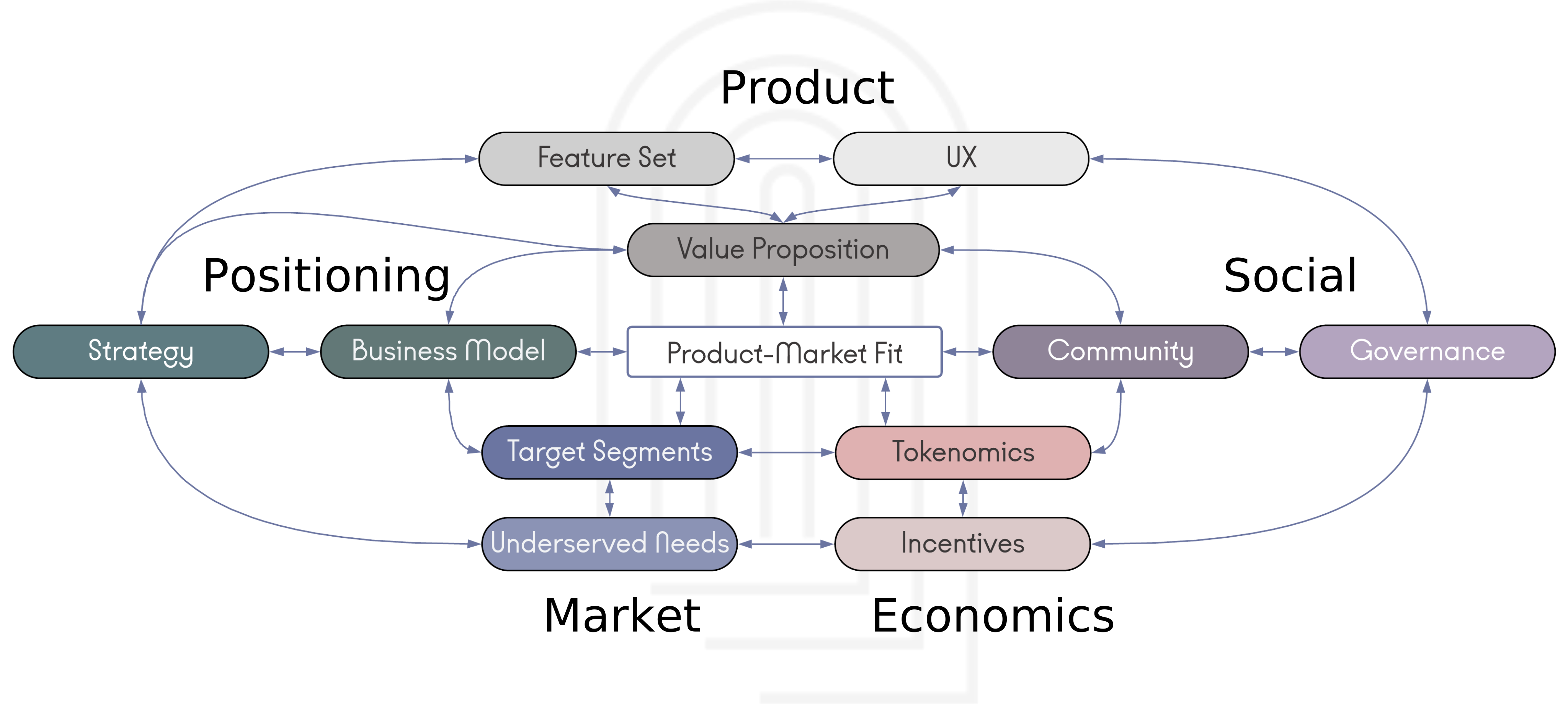
In the diagram above, product-market fit sits at the center of a living system.
- Market defines who the users are and what they need
- Product delivers on that need through features, UX, and value proposition
- Economics (tokenomics and incentives) determine how participation is sustained
- Governance provides legitimacy and decision-making
Each element feeds back into the others. For example, governance influences incentives, incentives shape community behavior, and community feedback shapes the product. These loops create a systemic balance, from which product-market fit emerges.
Therefore, real product-market fit is the equilibrium point where users keep coming back because the product solves something real, with each segment strengthening the ecosystem. Incentives amplify utility instead of masking a weakness. Governance decisions are seen as legitimate, so the community stays engaged. And value capture mechanisms sustain the system rather than draining it. The structure holds because no single edge carries all the weight. The task is to monitor where cracks appear and whether the system can be rebalanced effectively.
5) Time is the Ultimate Test
Bull markets bless everyone; bear markets reveal the real truth. Capital floods in, and dashboards look great. But that data tells you very little about staying power. The real test comes when conditions flip: when rewards taper, prices fall, and attention moves on.
From a measurement standpoint, that means looking at subsidy-adjusted metrics: usage cohorts that persist after incentives end, governance that remains active in bear markets, revenue streams that hold when speculative flows dry up.
Time doesn’t just filter hype; it will expose whether there is a foundation worth building on. In Web3, endurance across cycles is the only real proof of fit.
Takeaways for Product-Market Fit
Taken together, these realities show that product-market fit in Web3 is not just found once but maintained. Each protocol operates in an adaptive system, effectively inventing its own micro-economy. Thus, founders are not just building products, but are managing living markets, where fit emerges only when that internal economy stabilizes around a real utility rather than short-term incentives.
Beyond the Mirage: Where Real Product-Market Fit Holds
Before web3, product-market fit was a milestone: once you had it, you scaled. In Web3, it’s an “oasis”: something you have to keep tending, protecting, and re-earning through every cycle.
For founders, that means designing for governance legitimacy, resilient incentives, and communities that last. For investors, it means ignoring short-term signals and asking: Does this project stand on its own without subsidies, and will it still matter when the cycle resets?
Real product-market fit in Web3 doesn’t look like hype charts or sticky apps. It looks like a community that keeps building with you, even when the market turns against you. That’s the difference between a mirage and an oasis.
If you are looking for help with ‘Product-Market Fit’ for your startup and don’t know where to look, consider joining our founder’s community, or applying for advisory, consultation, or incubation on our website.
Sources / Research
Books
- Olsen Dan, The Lean Product Playbook: How to Innovate with Minimum Viable Products and Rapid Customer Feedback, Wiley, 2015
- Blank Steve, Bob Dorf, The Startup Owner’s Manual: The Step-By-Step Guide for Building a Great Company, K & S Ranch, 2012
- Beverungen Armin, Philip Mirowski, Edward Nik-Khah, Jens Schröter, Markets, Meson Press, 2019
- Bobek Vito, Tatjana Horvat, New Topics in Emerging Markets: Institutions and Knowledge Transfer, Springer, 2021
Journal Articles
- Zott Christoph, Raphael Amit, “The Fit Between Product Market Strategy and Business Model: Implications for Firm Performance”, Strategic Management Journal, 29 (1), 1-26, 2008
Web Articles
- Jason Rosenthal, a16z crypto, “How to Find Product-Market Fit: 5 Strategies for Web3”, 2024, https://a16zcrypto.com/posts/article/how-to-find-product-market-fit-5-strategies/ (accessed Oct 2025)
- Nitin Kumar, Cointelegraph, “The Product-Market Fit Nuances in Web3”, 2023, https://cointelegraph.com/innovation-circle/the-product-market-fit-nuances-in-web3 (accessed Oct 2025)
- Chainlink Labs, “How To Know When You Have Product-Market Fit”, 2022, https://blog.chain.link/product-market-fit-what-to-do-next/ (accessed Oct 2025)
- TFOCO Insight, “The Rise and Fall of Terra (LUNA): Key Takeaways for Investors”, 2022, https://tfoco.com/en/insights/articles/rise-and-fall-of-terra (accessed Oct 2025)